Lexington Herald-Leader | News
- 2.9
- Rating
- 10.00K
- Installs
- Free
- Price

 Analysis by App-foxy
I came away from Lexington Herald-Leader with the impression that it is most useful as a focused local-news companion rather than a complete replacement for every news source on a phone. Published by McClatchy, this free News & Magazines app is aimed at readers who want Eastern Kentucky coverage close at hand, including local breaking news, politics, business, weather, and sports. That focus is its main reason to install it, but it also sets a clear boundary: if you want broad national reporting, a large international news mix, or a highly customizable news reader, you may prefer another app alongside it.
I tested it with the habits I would use for a regional newspaper app: a quick morning scan, a check during a developing story, and a more deliberate read when local decisions or community events mattered. The experience is straightforward, but the value depends heavily on how closely your daily life connects to Lexington and Eastern Kentucky. It is not an app I would recommend simply because someone wants “more news.” I would recommend it to someone who wants local context that general-purpose news apps often push into the background.
How I used it for a dependable local-news routine
My baseline workflow was simple. I opened the app once to see what had changed, scanned the main headlines, and then chose only the stories that affected my interests. For a resident, that might mean weather before leaving home, local government during a public debate, business news when following an employer or development project, and sports later in the day. The advantage of a regional publication is that these subjects sit together in one place instead of being scattered across several unrelated sources.
You May Also Like

 AccuWeather: Weather Radar
AccuWeather Review: A Quick, Clear Forecast for Everyday Decisions
For everyday plans, the best forecast is the one you can understand quickly. AccuWeather makes rain timing, radar, and local conditions easy to act on, with a few trade-offs.

 Hill Climb Racing
Why Hill Climb Racing Still Turns Crashes Into One More Run
A tiny car, a bumpy hill and one more upgrade: Hill Climb Racing keeps resurfacing because its simple chaos makes every near-miss feel personal.

 AliExpress - Shopping App
AliExpress Makes Global Shopping Feel Personal, but Shoppers Bear the Risk
AliExpress turns a global marketplace into a pocket-sized discovery engine. Its reach is useful, its shopping loop compelling, and its trade-offs easy to miss.

 Lords Mobile: Kingdom Wars
Lords Mobile Is a Kingdom-Building Routine, Not a Quick Match
A case-by-case verdict on the building, battles, device demands, and social commitments that make Lords Mobile rewarding for some players and exhausting for others.

 PDF Scanner app - TapScanner
TapScanner Makes Paperwork Easier to Capture, Check, and Share
TapScanner makes scanning with a phone feel less like a rescue operation and more like a dependable step in getting work done. Its capture tools are useful, though not flawless.

 Block Blast!
 Shows How Much a Puzzle Game Can Leave Out
A quiet grid game shows why puzzle players increasingly value instant clarity, repeatable skill and low-pressure play—and where the genre still needs to catch up.
More From Our News Desk
View All News


The app’s store summary points directly to that mix of Eastern Kentucky reporting, and that emphasis is noticeable in how I think about its role. I would not open it expecting a general news digest with equal attention to every major national story. I would open it when the question is, “What is happening around here, and why does it matter locally?” That distinction makes the app more useful for people who already have a separate national news habit.
A realistic everyday scenario would be a morning commute during uncertain weather. I would check the weather coverage first, glance at breaking news for disruptions, and then save my deeper reading for later rather than trying to consume every headline before leaving. On a day with a local election, school issue, business announcement, or sports event, the same routine becomes more valuable because the app keeps the regional angle in front of me. It is a practical way to turn short visits into a consistent habit.
I also found that local apps reward selective reading more than endless scrolling. The best approach is not to treat the home screen as a feed that must be exhausted. Instead, I would look for the section connected to the reason I opened the app, read one or two relevant pieces, and close it. That prevents the experience from becoming a vague stream of headlines and makes the app feel like a tool rather than a time sink.
For someone new to the app, the first question is whether it covers the place they actually care about. The title identifies Lexington, while the wider editorial focus reaches Eastern Kentucky. If your interests are centered elsewhere, the local value drops quickly. A national aggregator may offer more breadth, and a city-specific source in another region may be a better fit. This is a location decision before it is a feature decision.
What I would check before making it part of my routine
The app is free to download, which makes trying it low risk, but it includes in-app purchases ranging from $7.99 to $159.99 per item. I would pay attention to any subscription or purchase prompt before committing to a long-term reading routine. The important practical point is not to assume that downloading a newspaper app means every part of the experience is permanently free. I would review the wording on any offer carefully and decide whether the access being presented matches how often I expect to read.
That matters especially for casual readers. If I only want occasional local headlines, I would use the free portion first and avoid making a purchase simply because a story caught my attention once. A frequent reader may see more value in paid access, but that decision should come after testing the app’s usefulness over several days. The price range is wide enough that the specific purchase deserves attention rather than a quick tap.
The age rating is Everyone 10+, so I would still use ordinary judgment when handing the phone to a younger family member. News can involve difficult subjects even when an app is broadly suitable for general audiences. The rating does not change the app’s purpose, but it is a reminder that local reporting can include serious events, crime, emergencies, and emotionally heavy community stories.
On Android, the current version is 11.1.16 and the app requires Android 8.0 or later. That makes compatibility an easy first check on an older phone. I would update the app before judging it, particularly if an earlier installation has been sitting unused for a while. A newspaper app is most useful when it opens reliably during a developing story, so keeping the installation current is a small but sensible part of the routine.
I would also check the phone’s notification controls instead of accepting every alert automatically. Breaking news can be useful when it concerns weather, travel, public safety, or a major local event. At the same time, too many alerts can turn a focused regional source into background noise. My preference would be to allow only the alerts that help me act, then open the app at a chosen time for everything else.
The same principle applies to mobile data and battery habits. I would read longer stories on Wi-Fi when convenient, especially if I planned to browse several sections. I would not leave the app open all day waiting for updates. Opening it intentionally gives me more control and makes it easier to tell whether the information is genuinely useful or merely interrupting me.
Shortcuts and repeatable patterns that make it more useful
The fastest pattern I found was to give each visit a question. “Is the weather going to affect my plans?” “What changed in local politics?” “Is there a business story I need to understand?” “What is happening in sports?” A question narrows the scan and helps me avoid reading headlines without retaining anything. This is more effective than opening the app repeatedly with no purpose.
For breaking news, I would use a two-pass method. The first pass is only for orientation: identify what happened, where it happened, and whether it affects me. The second pass comes later, after more reporting may be available. That habit is particularly important with fast-moving local events, where an early headline may be useful as a warning but not enough for a complete understanding. The app can start the process, while patience improves the quality of the conclusion.
For politics and business, I would read beyond the first headline and compare the immediate event with the surrounding explanation. Local decisions often matter because of their practical effects on roads, schools, services, jobs, development, or household costs. A quick headline scan can tell me that something changed; a fuller article is more likely to explain who is affected and what happens next. That is where a regional newspaper app can be more valuable than a generic trending-news list.
Sports use benefits from a different rhythm. I would check before an event for the local angle, then return afterward for the result or follow-up. This keeps sports from competing with urgent news during the day. It also gives the app a place in a routine without forcing every section into the same reading pattern.
One useful habit is to separate “need to know” from “want to explore.” I would first handle weather, breaking news, and anything connected to a personal deadline. Only then would I browse business, politics, or sports stories out of curiosity. That order makes the app practical on busy days and more enjoyable when I have time. It also helps me decide whether a paid option would be worthwhile: frequent, purposeful use is a stronger reason than occasional impulse reading.
I would keep a second source available for national and international coverage. That is not a criticism of this app; it is a consequence of its regional purpose. A general news app can provide breadth, while Lexington Herald-Leader can provide a closer local lens. Combining them is more sensible than expecting either one to do both jobs equally well.
Where the focused approach reaches its limits
The biggest limitation is scope. Readers who want one application to cover worldwide events, technology, entertainment, finance, and local reporting may find the experience too narrow. The app’s strength is also its constraint: it concentrates on Eastern Kentucky topics instead of trying to be everything. If your location or interests change, its usefulness may change with them.
The average rating is 2.9 from around 198 ratings, with around 76 written reviews. I would treat that as a reason to test the current experience personally rather than as an automatic rejection. Ratings can reflect different expectations, phone models, account experiences, and reactions to paid access. Still, the score tells me to keep expectations realistic and to pay attention to stability, navigation, and purchase prompts on my own device.
Another limitation is that a newspaper app may not satisfy readers who prefer a completely neutral, multi-source presentation. This app represents the Lexington Herald-Leader’s own regional publishing approach. That can be an advantage when I want a coherent local viewpoint, but it is less suitable when I want several outlets presented side by side. For comparison shopping on a story, I would use a broader news reader or visit additional sources rather than relying on one publication alone.
I would also avoid assuming that every headline deserves immediate attention. Local news can feel personally relevant, which makes it easy to react before reading carefully. My workaround is to distinguish an alert from an explanation. An alert tells me to look; the article helps me understand. If the topic affects safety, travel, money, or a public decision, I would verify important details through the full report and, when appropriate, another reliable source.
The purchase range creates another trade-off. A dedicated local reader may be worth paying for if it becomes part of everyday life, but it is harder to justify for someone who checks only once or twice a month. I would not choose a purchase based on the app’s free installation alone. I would first measure how often I return, which sections I use, and whether the local reporting gives me something I cannot easily replace with general headlines.
People using older Android devices should check the operating-system requirement before spending time setting up the app. Android 8.0 is the minimum, so a phone below that level is not a practical match. For supported devices, I would still keep enough free storage and install updates normally, because reliability matters more than any single interface preference when news is time-sensitive.
Who should install it, and who should choose something else
I think this app is a good fit for Lexington-area readers, Eastern Kentucky residents, former residents who still follow the region, and anyone with family or work connections there. It is also useful for people who want their local weather, politics, business, and sports coverage gathered around one regional publication instead of discovered through unrelated searches.
It is less suitable for someone who has no connection to the area, wants a worldwide news dashboard, or dislikes publication-specific apps. I would also steer away from it if I wanted a purely headline-based experience with many sources and extensive personalization. A general aggregator would be more efficient in that situation, while a weather-first app would be better for someone whose only concern is forecasts and alerts.
For readers who mainly follow local sports, a dedicated team or league source might provide more specialized detail. For readers focused on public affairs, combining this app with official public notices or meeting information may be wiser than treating one news article as the entire record. The app is best understood as a strong starting point for regional awareness, not a substitute for every specialized source.
Its free entry point makes experimentation easy. I would install it, use the morning scan and one evening check for several days, adjust notifications, and then decide whether it deserves a permanent place on my home screen. That trial reveals more than the rating alone because the central question is personal: does the Lexington and Eastern Kentucky focus consistently answer questions I actually have?
My final view after building a habit around it
Lexington Herald-Leader | News works best when I use it deliberately. The app gives local reporting a clear place in my day, and its coverage areas make it easy to build a routine around weather, breaking news, politics, business, and sports. I appreciate that it can complement a national news app instead of forcing me to choose between local relevance and wider coverage.
My recommendation comes with conditions. Keep notifications selective, read beyond urgent headlines, check purchase terms carefully, and pair the app with another source when you need broader or independent comparison. Those habits address the main friction points without pretending the app is a universal news solution.
McClatchy’s app has a clear audience, and I would recommend it to that audience: people who genuinely care about Lexington and Eastern Kentucky and want a repeatable way to stay informed. I would skip it if my news needs were national, international, or heavily multi-source. With that expectation set correctly, the app feels more useful and less disappointing. After using it, my verdict is straightforward: choose it for regional awareness, not for an all-purpose news replacement.
FAQs for Lexington Herald-Leader | News
01What is Lexington Herald-Leader | News?
Lexington Herald-Leader | News is the mobile news app for readers who want coverage of Lexington, Central Kentucky, and surrounding communities. From the app, users can browse local and regional headlines, read full articles, follow breaking developments, and explore topics such as politics, education, business, sports, entertainment, and community news in one place.
02Is the Lexington Herald-Leader app free to download and use?
The app can generally be downloaded at no cost, allowing users to install it and view available content. However, access to all articles and premium features may depend on a subscription or account. Some stories may be limited for non-subscribers, so users should review the current pricing, trial terms, and access conditions shown in the app or official store listing.
03What kind of news and features are available in the app?
The application focuses primarily on local journalism, including breaking news, investigative reporting, sports coverage, weather-related updates, opinion pieces, and stories about Kentucky communities. Depending on the version and account status, it may also offer personalized sections, saved articles, notifications, digital edition access, multimedia content, and convenient navigation between the most important news categories.
04Does the app require an account or subscription?
You may be able to open the app and read some freely available stories without creating an account, but an account can be required for personalized features, saved content, newsletters, or subscriber-only articles. Full access is commonly tied to a digital subscription. Before subscribing, check renewal details, billing frequency, cancellation rules, and whether an introductory offer automatically changes to the standard price.
05Can I receive breaking-news notifications from Lexington Herald-Leader?
Yes, the app may support push notifications for breaking news, important local developments, sports updates, and other selected topics. Notifications normally require permission from your device, and you can manage them through the app or your phone’s settings. If you prefer fewer interruptions, it is worth customizing alerts so you receive only the categories that matter most to you.
Pros
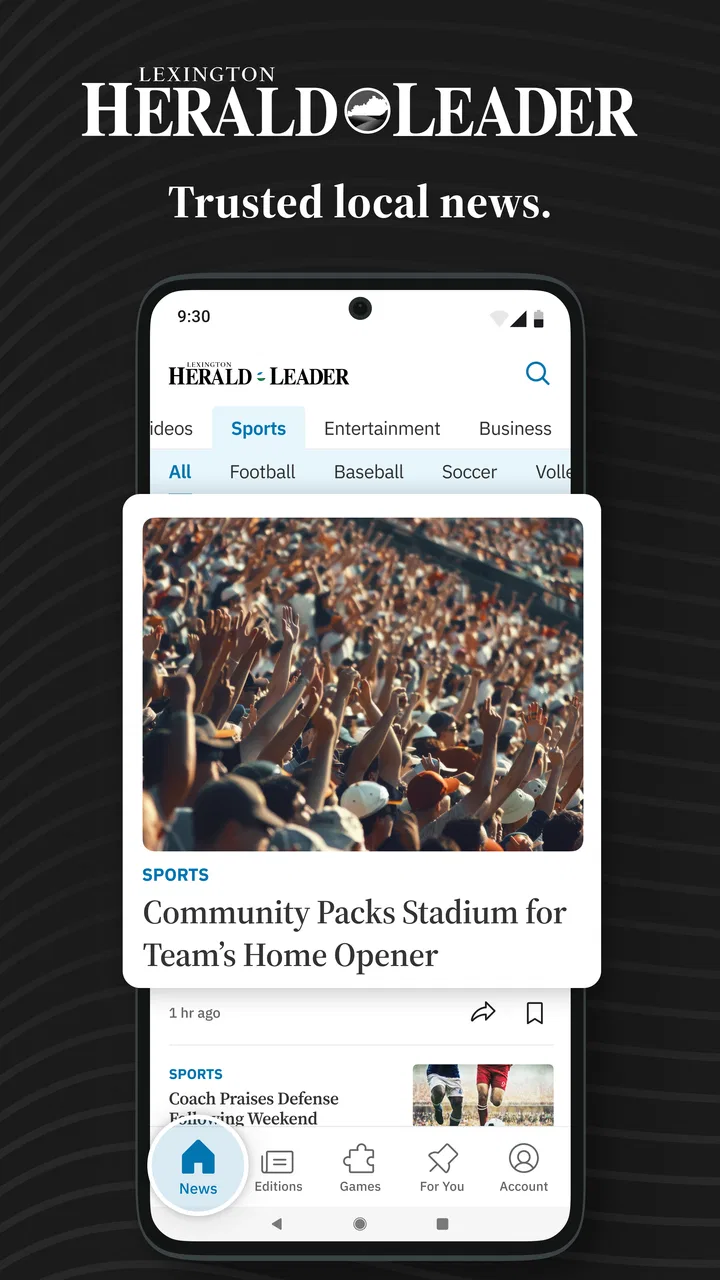
- Covers local Kentucky news with strong regional relevance.
- Offers timely updates on breaking stories and community events.
- Includes sports coverage focused on the Wildcats and local teams.
- Provides investigative and in-depth reporting beyond daily headlines.
- Clean layout makes browsing articles and sections straightforward.
Cons
- Some premium articles may require a paid subscription to read.
- Advertising can interrupt browsing and reduce the reading space.
- Coverage is mainly regional and may feel limited for national news.
- Certain features may depend on a stable internet connection.
- App performance and article availability can vary after updates.

Lexington Herald-Leader | News
Gallery